Mastering AI: From Prompt to Product
AI amplifies. You decide.
We have spent the past several months experimenting with AI. No hype, no fear. Just what we found.
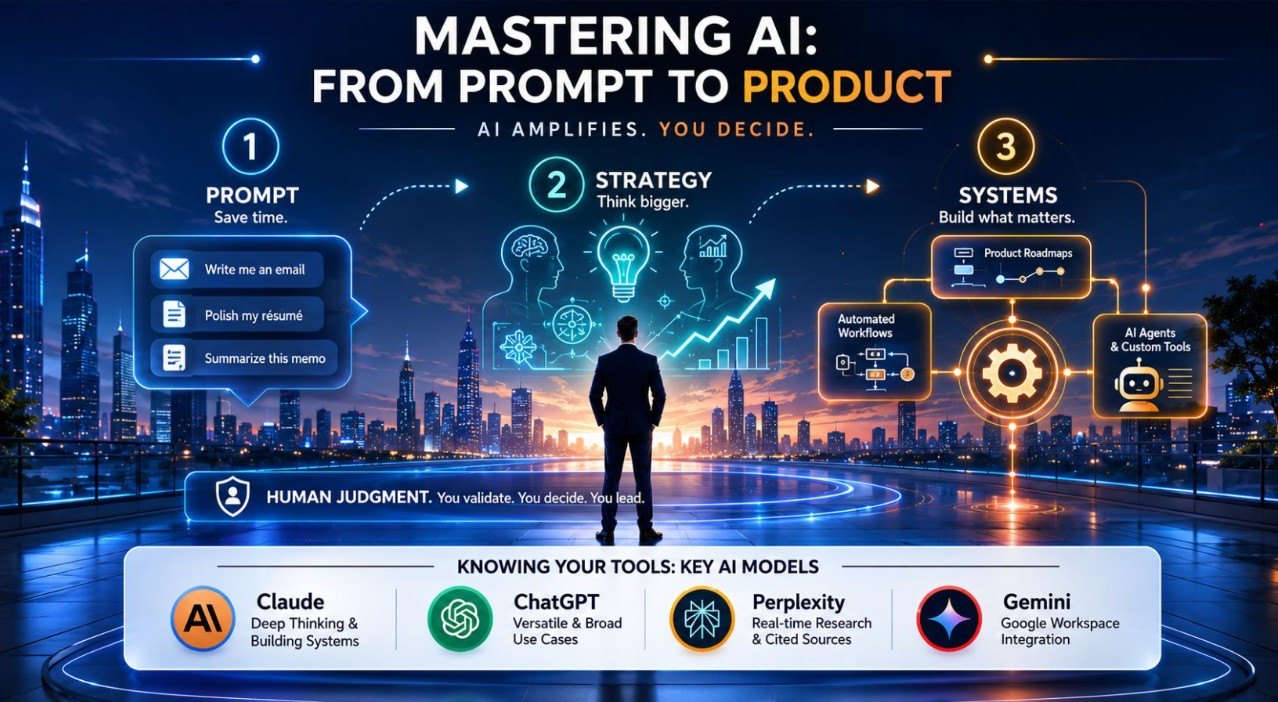
Most people use AI for one thing: emails, résumés, cleaning up a memo. That is where nearly everyone starts. The shift comes when you go deeper and use AI to build things that were out of reach before: product roadmaps, automated workflows, custom tools and systems. In our experience, work that once took a small team several weeks can sometimes take a focused afternoon.
Not all AI use is equal. We think about it in three levels:
- Level 1, the prompt. “Write me an email.” Everyone starts here. It saves time, but it is only the tip of the iceberg.
- Level 2, strategy and thinking partner. Pressure-test an idea, map a roadmap, brainstorm go-to-market. This is where AI stops being a writer and starts being a collaborator.
- Level 3, systems and agents. Define the problem, build the requirements, let AI create the tool, then iterate in short sprints. Faster and leaner than the spreadsheet it replaces.
At every level, one thing stays constant: a human still has to validate the output, make the call and own the decision. That is not a flaw. That is by design. It is called artificial intelligence for a reason.
Different tools suit different jobs. Our take as of mid-2026, and the tools change quickly:
- Claude (Anthropic): deep thinking, building systems, long documents and complex reasoning. Our go-to for strategy and creating tools.
- ChatGPT (OpenAI): versatile and widely adopted, great for broad use cases and quick iterations. The one most people start with, for good reason.
- Perplexity: real-time web research with cited sources. The first stop to understand a topic or market fast.
- Gemini (Google): deep integration with Google Workspace. If you live in Docs, Sheets and Gmail, it fits your workflow naturally.
Their capabilities overlap, but each suits different jobs. In customer operations, for example, one might draft a renewal summary from account notes while another researches the customer’s market. The smartest move is not picking one. It is knowing which to reach for, and when.
We also hear that AI will kill creativity. It can, if it is used to avoid thinking. Used well, it does the opposite and pushes people to think more clearly and write with more intention. Like any tool, it depends on how you use it.
Our advice is to try them and form your own view. Do not let someone else’s pessimism become your ceiling. In client work we follow the same order we recommend here: design the process first, then decide where AI helps.
Related service: Fractional Leadership. Interim or part-time leadership to put AI to work in Customer Success and Service Delivery.